The 6-Layer Operating Model
Rather than a flat organizational chart, the operating model acts as an “organizational operating system” that safely and continuously translates strategic human intent into compiled, verified digital outputs.
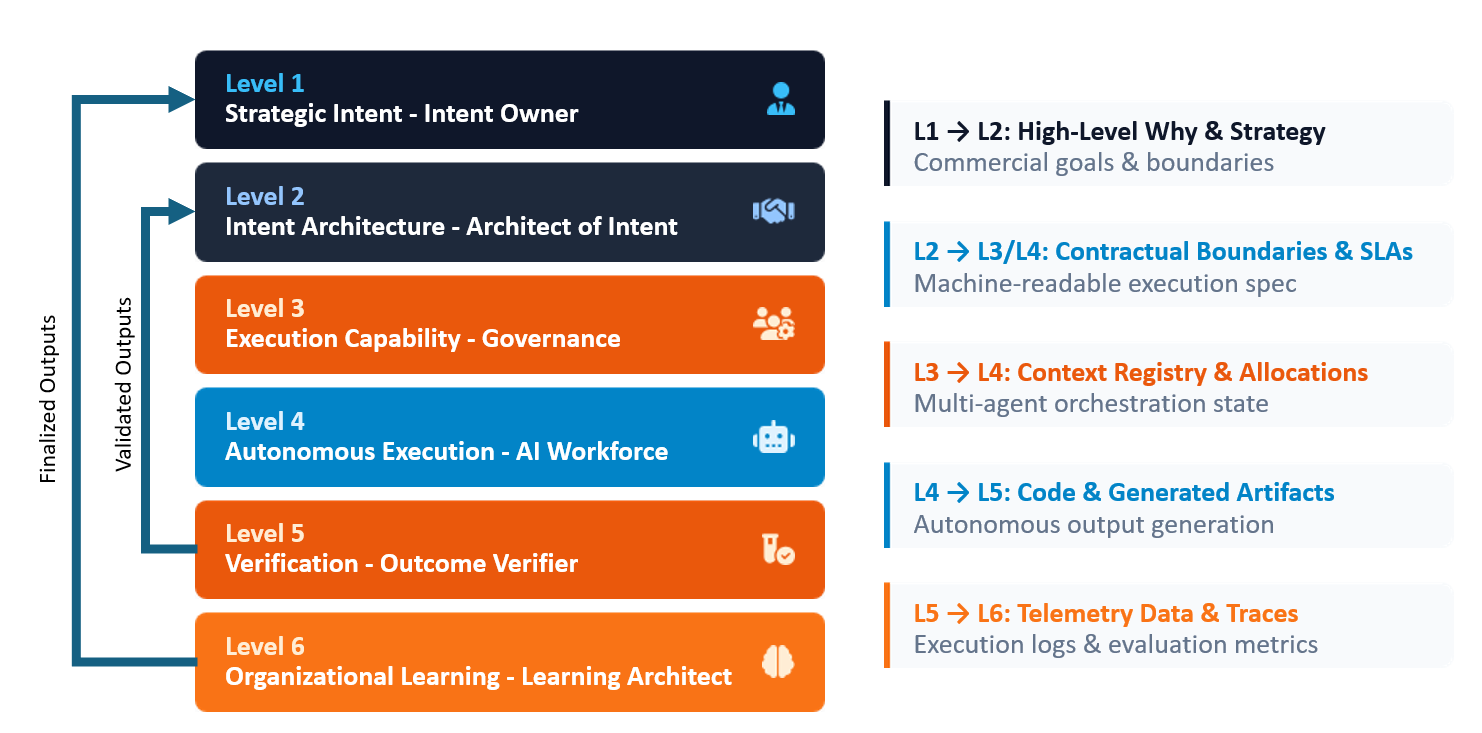
Strategic Intent
Defines the high-level “why” behind an initiative, establishing commercial objectives, target metrics, and constraints — without defining technical implementation.
Intent Architecture
Translates strategic objectives into an Execution Contract: a strongly typed, machine-readable specification detailing boundaries, dependencies, SLAs, and quality gates.
Execution Capability
Houses the persistent multi-agent orchestration engines, context registries, and memory systems that manage the persistent AI workforce.
Autonomous Execution
Triggered by a Task Operator, specialized autonomous agents collaborate inside secure sandboxes to plan, write, compile, and test code, running iterative loops autonomously.
Verification
Focuses entirely on programmatically validating outcomes against the criteria specified in the Execution Contract via static, dynamic, and LLM-as-a-Judge gates.
Organizational Learning
Captures telemetry, traces execution paths, and runs pattern extraction on manual human adjustments to permanently update the organization's context databases.
A self-improving circle
Unlike traditional project management frameworks that dissolve teams and discard tribal knowledge upon completion, the Architecture of Intent maintains a permanent execution capability that grows smarter with every task.
See it in motion
The technical topology, the Execution Contract, and the governance flow that make these six layers run day to day.
How It Works