How It Works
The tightly governed human-infrastructure system, the contract that encodes intent, and the flow of approval that keeps the AI workforce accountable.
A tightly governed human-infrastructure system
To ensure secure and compliant execution, the platform architecture is built around a small set of core components.
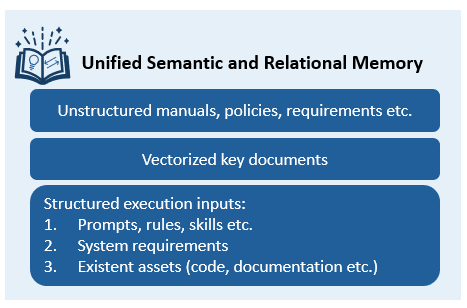
Unified Semantic & Relational Memory
Co-locates relational dependency mappings alongside vectorized guidelines and corporate standards in one knowledge base — unstructured documents, vectorized policies, structured rules, prompts, and skills. Agents query software architectures and style parameters at runtime so they don't break legacy integrations.
Virtual Sandboxed Workspaces
All execution and compilation of generated code occur inside secure virtual machine runtimes. Agents run recursive self-correction loops until every requirement and test passes, shielding production and other development streams from unsafe operations.
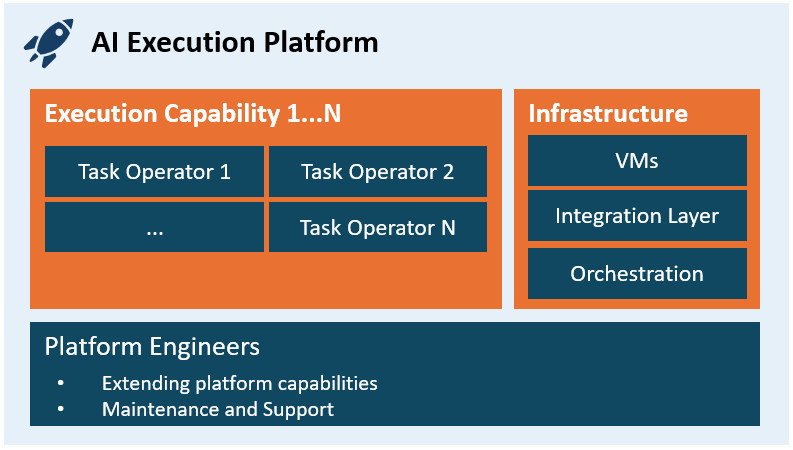
Execution Platform
Holds multiple Execution Capabilities, each built around a specific business or technical solution. Every Execution Capability consists of Task Operators — agents, pipelines, instructions, and mechanisms for handling context, dependencies, and limitations for specific task types.
Multi-Stage Automated Quality Gates
Every Task Operator output is verified through the verification pipeline (default) or approved by the AoI (optional). Static scanners, dynamic testing, non-functional checks, and an independent LLM-as-a-Judge audit run before anything is accepted.
Telemetry & Pattern Extraction Pipeline
The orchestration platform logs every agent decision path, latency profile, and context lookup. When a human senior engineer applies a manual adjustment to a verified output before merging, a pattern extraction engine isolates the delta, abstracts the optimized pattern, and commits it back to the central context and assets database — compounding the system's execution capability over time.

The Execution Contract
Stored and executed through the UI management system, with full traceability and auditability, integrated with the Execution Platform and corporate reporting.
1. Workload Metadata
Registers the unique identity, ownership, and priority.
2. Strategic Intent & Objectives
Declares the strategic “why” and expected functional outcomes, guiding the AI workforce toward the goal while allowing autonomous pathfinding.
3. Autonomy Boundaries & Constraints
Defines strict technical limitations and prohibited actions to ensure security, architectural alignment, and regulatory compliance.
4. Cost-Governance Harness
Establishes hard budget caps, token allocations, and recursion limits to prevent runaway compute costs during autonomous self-correction loops.
5. Verification & Trust Gates
Defines the programmatic testing criteria, security scanners, and qualitative judge models that must be passed inside the isolated sandbox before release.
6. Specific Inputs
Directly links required policies, manuals, documents, samples, context limitations, types of analysis required, test data, etc.
De-bottlenecking the Architect of Intent
Does the Architect of Intent just become the new bottleneck of corporate production? Three structural mechanisms prevent it.
Pre-Packaged Task Operators and Auto-Injected Context
The organization maintains a library of pre-packaged, standardized Task Operators (such as “Deploy API Endpoint” or “Design Checkout Page”) that encapsulate 95% of the required system context, security rules, and style parameters. The AoI simply specifies the remaining 5% of unique variables and business constraints.
Boundary Specification Is Exponentially Faster Than Execution
Writing, debugging, compiling, and testing code manually takes days or weeks. Declaring what success looks like, what budget ceilings exist, and what constraints must be respected is a declarative process that takes minutes — the AI workforce handles the complex pathfinding and execution.
Democratized and Decentralized Decision Formulation
Because the platform shields practitioners from low-level technical execution, non-technical stakeholders, domain experts, and project managers can input their intent directly. The Architect of Intent acts as a system-level governor and validator of these boundaries, rather than a bureaucratic gatekeeper for every individual request.
The flow of approval
If an AI workforce can generate software almost instantly, high-latency manual approval loops collapse. Four pillars restructure how approval works instead.
Programmatic Verification Gates
Success and quality gates are encoded directly inside the Execution Contract upfront, using a Test-Driven-Development approach. Static code scans, dynamic tests, and independent machine-driven audits run in isolated sandboxes — satisfying every programmatic criterion means the output is validated.
Delta Auditing
SMEs and human engineers don't review entire generated systems — only the “delta”: unique business logic, critical changes, or manual tweaks. High-risk decisions hit a predefined Human-in-the-Loop checkpoint with a targeted visual diff before the autonomous loop resumes.
Shifting Approval to Live-Market Feasibility
Because the AI workforce can generate functional MVPs almost instantly, the business can shift final approval directly to the live market. Real-world response becomes the ultimate validator, turning approval into a data-driven decision.
Learning Layer
When a human SME or developer manually changes a generated output before merge, the Learning Layer captures the change, isolates the delta, and updates the shared context database — so the next similar contract applies the new pattern automatically.
Rolling it out: the evolutionary SDLC transition
The enterprise migrates horizontally across the Software Development Life Cycle, function-by-function rather than department-by-department — building a permanent, compounding execution capability without disrupting active delivery streams.
Preconditions
Automated quality control capabilities, the ability to gather and process telemetry, infrastructure management (CI, orchestration, virtualization, etc.), a task management system, a defined and documented SDLC, and a centralized enterprise knowledge base.
- 1
Identify the area
Identify the function and specific type of solution to address, at the right level of atomization to keep context optimized — e.g. Landing Page Creation Capability, Release Package Preparation Capability, C# Code Review Capability. Don't overextend the area; current AI model capabilities are limited.
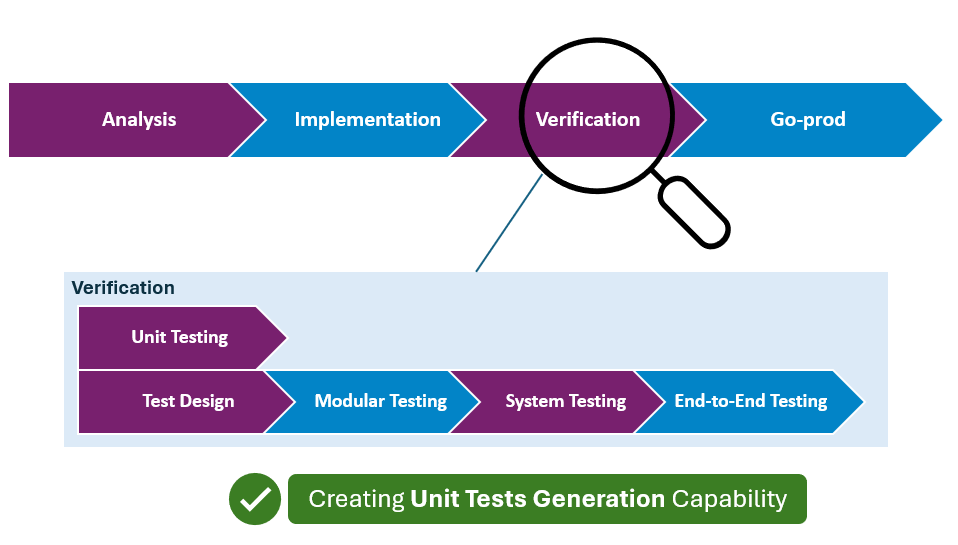
Diving into the SDLC to identify areas, functions, and activities that can be automated and verified — illustrated for a generic process. - 2
Build the instruction set
Based on existing policies, approach documents, manuals, and examples, produce a document store, a vectorized set of key documents, and an instructions summary for the future Execution Capability.
- 3
Segregate into Task Operators
Break the Capability into Task Operators, each producing a verifiable outcome that can be manually and automatically tested.
- 4
Build the Capability
Build it out as part of the Execution Platform — context, input-capture mechanisms, integrations to tools and data storages, and output verification.
- 5
Set the infrastructure
Provision the infrastructure required for specific task execution. Optionally, create a dataset of existing examples, requirements, and documentation to automatically build context.
- 6
Roll out
Integrate with the existing SDLC, provide training, and cover edge cases.
Who's accountable at each step?
Delegation never transfers responsibility. See the full role directory and phase-by-phase accountability matrix.
Roles & Accountability