Case Studies
Two Execution Capabilities running against real production workloads, with measured time and capacity outcomes.
From business requirements to implementation-ready functional requirements
Deploying an AI-enabled Execution Capability around the existing Business Analysis process. Prior to deployment, 10 business analysts performed these tasks manually.
The traditional bottleneck
The team of 10 analysts spent most of their time on manual, sequential administrative and document-generation tasks — moving an initial business idea through a feasibility study to engineering handoff across nineteen separate stages: competitor research, existing-behavior analysis, risk assessments, feasibility study, functional specifications, acceptance criteria, UI mockups, and more. Documentation and translation overhead left little time for strategic thinking; limited capacity meant cutting corners, leading to implementation delays, inconsistent documentation, and mixed user feedback.
Deploying the AI-powered Execution Capability
Instead of relying on unguided AI chatbots or manual prompt-engineering, the system co-located external market research, competitor intelligence, existing product documentation, corporate writing standards, and design-system tokens in a unified intelligence core. The workflow ran across two automated execution stages, each governed directly by the human analyst with access to interim artefacts:
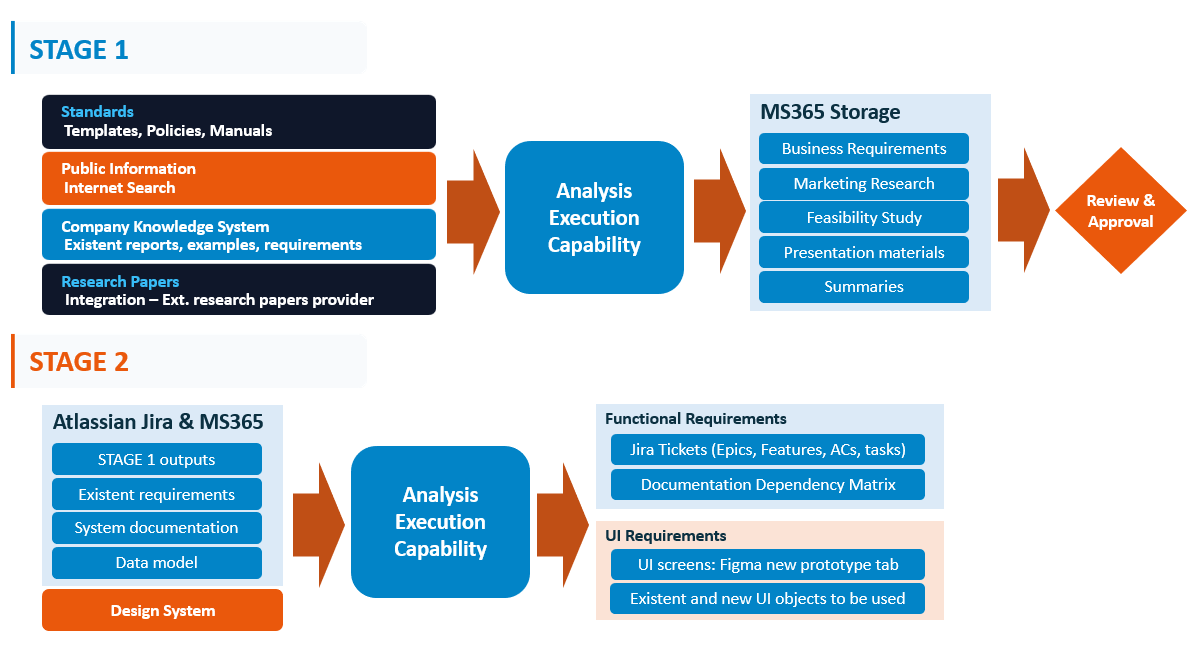
Intent to Comprehensive Business Analysis. The analyst declared the core business idea in natural language; the platform compiled structured market, competitor, existing-behavior, BRD, feasibility, and risk analyses — an instant starting point instead of weeks of manual research.
Dynamic Approval Packaging. The capability compiled analytical findings into structured executive summaries and stakeholder presentation materials.
Programmatic Requirements Decomposition. Using requirements-writing templates, organizational glossaries, and Jira schemas, high-level goals were decomposed into Business Requirement → High-Level Requirement → Functional Requirement → Acceptance Criteria, flowing directly into Atlassian Jira as tickets ready to review.
Interactive Design System Integration. A secondary capability read the company's Figma component libraries and design tokens to automatically construct proposed UI/UX changes, returned to the analyst for visual review.
The human-in-the-loop model
The deployment redirected BAs' capacity from tedious information gathering, manual documentation, and administrative work toward defining high-level intent, challenging assumptions, refining acceptance criteria, and approving proposed functionality — all automatically stored in enterprise systems. The company's product manuals, legacy behavior descriptions, and historical examples became active inputs to the generation pipeline, so tribal knowledge was preserved rather than lost.

Automating release readiness and policy-driven package generation
Once a development cycle is complete, the traditional path to production runs through manual review and preparation — inspecting features, verifying code branches, mapping dependencies, writing migration scripts, checking compliance, and drafting rollback procedures from scratch.
The gap it closes
Because release checklists were traditionally prepared one feature at a time, teams could miss specifics — like dependencies between separate features scheduled for the same release window, a process prone to human error. The organization deployed an AI-powered Release Package Preparation Execution Capability that shifts release preparation from a manual, feature-centric documentation exercise into a policy-driven automated verification system, scanning the entire release scope and cross-referencing all accompanying code modules, bug fixes, schema updates, configuration changes, and integrations.
Identifying the specific files modified, affected internal services, new dependencies introduced, and the exact compliance rules triggered by the unique feature — preparing all artefacts related to the feature release.
Evaluating how different release items scheduled for simultaneous deployment interact — shared database dependencies, deployment sequencing, configuration conflicts, and whether one item's migration script breaks another's rollback strategy. Draft tasks are created for the DevOps and Ops teams.
The Complete Release Package
Once validations are complete, the Execution Capability automatically compiles pre- and post-release operational checklists, rollback instructions, deployment sequences, monitoring criteria, and automated release notes. The AI workforce handles data gathering, branch verification, and package drafting, while the human engineering and delivery team retains full control to audit, validate, and sign off.
Read the full methodology
These two capabilities are examples of the broader Architecture of Intent — read the complete white paper for the full model.
Get the White Paper